
We don’t always get to pick who we work with.
I spent a decade running operational teams and built a way of reading how a group is actually put together. I run it with teams over two sessions, then I get out of the way.
Most team problems are not people problems.
- 01
The same two people grind on the same kind of decision, and it gets filed as a personality clash and managed around forever.
- 02
Work stalls in the same place on every project, because the gap is in the team rather than in the project.
- 03
Everyone is good. The mix is not. Five people who lead with the same instinct leave a whole stage of the work unattended.
Five Dimensional Teams
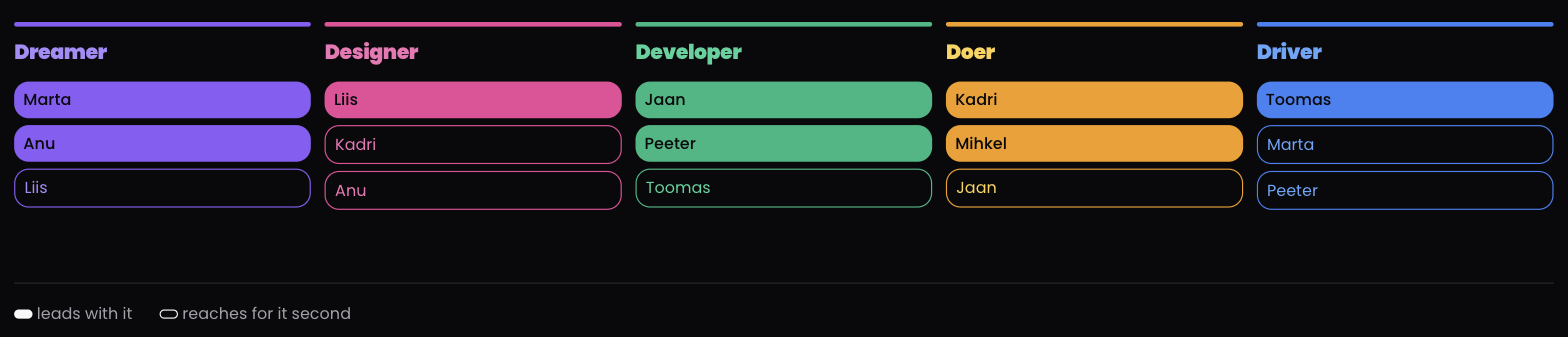
Every piece of work travels the same road, from someone imagining it to someone being accountable for it landing. Five ways of working carry it.
Ten pairings among five people. Touch one.
Which two are you?
Ten situations, one instinct each, about three minutes. You get your leading dimension, the one you reach for second, your named blind spot, and who you are most likely to grind against. No sign-up, nothing stored, nothing to cancel.
Nobody is one of these. You lead with one and reach for a second, and the pair you land on is what people actually experience of you. There is no order to travel them in and no best one to be — which is why two strong people can still grind, and why a room full of talent can leave a whole stage of the work with nobody on it.
A facilitated session for your whole team.
Two 90-minute sessions, a week apart, online, for five to ten people — and the week between them is the widest part on purpose.
Ten questions
Three minutes each. One link to share, nothing to organise.
How your team is built
Where the mix is concentrated, which stage nobody is minding, and which pairs will grind — named out loud, in the room.
You watch it happen
The team starts recognising the patterns in real meetings. That is what turns a model into something they use.
What to do about it
We work what you actually hit that week, and finish with commitments that have names on them.
A report, by hand
Composition, every profile, the remedy for each friction point. No licence, no expiry.
Five to ten people in the room. Below five the pairings thin out and the session stops working — it is a floor on the format, not a judgement on the team.
Nothing is committed on that call. If this is not the right thing for your team I will say so.
- Both 90-minute sessions, run by me
- The assessment for everyone beforehand — free, and free forever after
- Every individual profile, with each person’s blind spot named
- Your team’s composition, and the stage of the work nobody is minding
- The specific remedy for each friction point, not general advice
- A written team report afterwards, by hand — yours to keep, no licence, no expiry
Online, on your own video platform. In person is possible and costs more; I will quote it rather than bundle it.
Invoiced on completion. No subscription, no per-seat licence, nothing that renews without you noticing.
They are not another €99. The assessment is free and stays free, so you map them in three minutes.
These are not clients. They are people I managed.
Nic had a system he used to make a team work — the 5D team system. “Which one are you?” he asked. After some consideration, I realised I am a Dreamer and a Designer, but not always much of a Doer. From there we set goals and targets for how to upskill in the areas where I was not fully there yet. […] Nic came in with a system that genuinely worked, and it helped me and the rest of the team reach our goals while feeling good about ourselves. Two years on, the results speak for themselves: his former team members have gone on to earn promotions and land their dream jobs.
 Dreamer · Designer
Nic is one of the most motivating mentors I have had in my professional career. He understood where I needed to be pushed and where I would excel the most. When he first introduced me to his 5-dimensional teams concept, it clicked to me what people I work with the best, what work best cultivates my talent and now the talent of my own team, and how to build a good, balanced and strong team.

Both of these are people I managed, years before there was a company. That is the honest shape of it: the method is a decade old and the business is months old, and I would rather say so than dress up a mentee as a customer.
This is the session, from my side of the screen.
No slides. I drive your team live — the whole room on one screen, and any two people linked while everybody watches. Every word was written by hand in advance, which is why the same answers always produce the same reading.
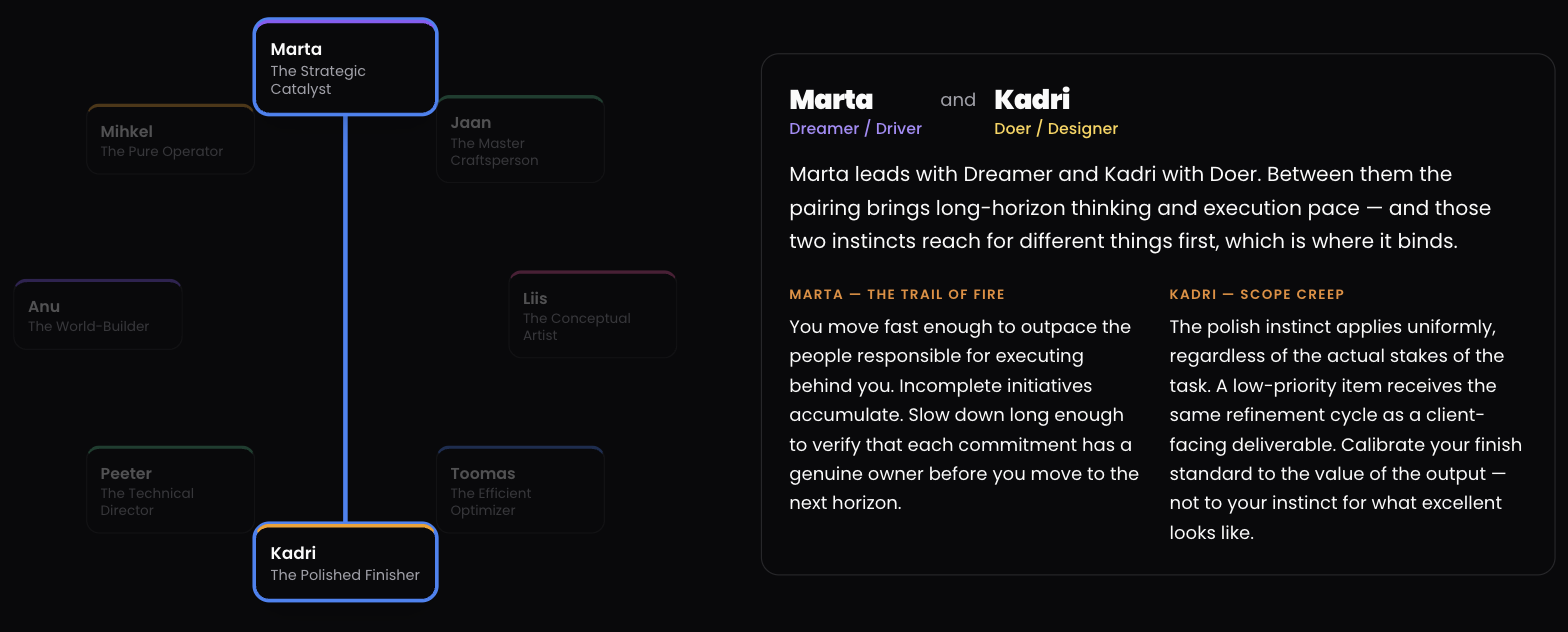
The report is true on the day I write it. Six months later somebody has gone, two have joined, and the shape of the team is not the shape in the document.
pairings in a team of ten — and every joiner rewrites them.
The new person takes the free assessment and has their own profile in three minutes. After that you are on your own, working the rest out by hand. That is better than nothing and it is not good enough.
So I am putting this screen in your hands.
The same instrument, without me in the room. Add a person and it re-reads the whole team rather than handing you one more profile to file.
Not finished, and I will not pretend otherwise. No accounts, nothing stored my side, nothing sent to an AI. Free to start when it lands.
I want to help people help people.

Almost everyone who manages a team was promoted for being good at something else. Then they inherit a group they did not choose, and learn how it fits together the slow way — one uncomfortable meeting at a time, over about two years.
I built this to stop doing it by feel. It is not research. It is ten years of running teams, being wrong about them, and correcting it.
It is also why the assessment is free and always will be. A map people have to buy their way onto is not much of a map.

The questions that come up every time.
What happens when I get in touch?
You pick a time and we talk for twenty minutes, or you write to me — whichever suits you. Either way it is about the team and what keeps happening in it. Nothing is booked or invoiced from that conversation. If it is not the right thing for your situation I will say so, because a session run on the wrong problem helps nobody and I would rather not take the money.
How many people can take part?
Up to ten. Beyond that the relational work stops being useful in one room, so a larger group runs as two cohorts — and I will say so before you book rather than after.
Do we need to prepare anything?
No. Everyone takes a three-minute assessment beforehand. That is the whole ask.
Is this online or in person?
Online by default, hosted on your own video platform. It keeps the price down and means a distributed team joins on equal footing rather than half a room and half a screen. In person is available where it genuinely suits the team — it costs more, because it is a full day plus travel, and I will quote it honestly rather than bundling it in.
What if the team is sceptical about personality tests?
Good — the sceptics usually get the most out of it. This is not a test that sorts people into boxes and stops. It describes what predictably happens between two specific people, which is checkable against their own experience. If it does not match, they will say so, and that is a useful session too.
What happens to our data?
It stays with us and is never sent to an AI. Every profile was written in advance by a human, so the same answers always produce the same result.